
Walls
Soundproofing Walls in Polish Apartments and Houses
A practical breakdown of wall types found in Poland and the most effective approaches to reducing sound transmission through them.
Read articleA reference covering soundproofing methods, material specifications, and practical installation approaches for residential and commercial buildings in Poland.
Core Topics
Acoustic treatment in buildings involves more than placing foam on a wall. Effective noise reduction depends on the combination of mass, decoupling, absorption, and sealing. The articles below address each of these areas with specific reference to materials commonly available in Poland.
Methods for adding acoustic mass and decoupling to internal partition walls and external facades in Polish apartment blocks and houses.
An overview of mineral wool, acoustic foam, wood wool panels, and mass-loaded vinyl — their absorption coefficients and typical uses.
How glazing configurations, frame sealing, and door mass affect sound transmission. Includes typical Rw values for products available in Poland.
Articles
Walls
A practical breakdown of wall types found in Poland and the most effective approaches to reducing sound transmission through them.
Read article
Materials
Mineral wool, acoustic foam, wood wool boards, and mass-loaded vinyl compared across absorption class, weight, and application context.
Read article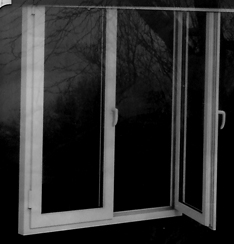
Windows & Doors
How window glazing configurations and door construction influence sound insulation ratings, with reference to commonly available options in Polish construction.
Read articleContext
Polish construction follows European standards, primarily the EN ISO 10140 series for laboratory measurement of airborne and impact sound insulation. Minimum requirements for residential buildings are defined in PN-B-02151, the national standard covering acoustic protection in buildings.
For partition walls between dwellings, the standard requires a minimum weighted apparent sound reduction index (R'w) of 50 dB. Floors must achieve a minimum impact sound pressure level of 58 dB (L'n,w). These values apply to buildings constructed under permits issued after 1 January 1999.
Buildings from earlier periods, particularly the large-panel block constructions (wielka płyta) built during the 1960s–1980s, frequently do not meet these thresholds, which creates the practical need for retrofitting acoustic treatments described in these articles.
Key Polish Standard
PN-B-02151-3:2015 — Acoustic protection in buildings. Part 3: Design requirements and verification.
Sets minimum insulation values for internal partitions, external walls, roofs, and floors in residential, educational, and healthcare buildings.
Measurement Reference
Laboratory sound insulation testing in Poland follows PN-EN ISO 10140, which aligns with the European and international ISO methodology for measuring airborne and impact sound reduction.
Contact
If you have a question about a specific acoustic situation, a material not covered here, or a correction to existing content, use the form.
This site does not provide commercial services. The contact form is for informational correspondence only.